
Crunch Time For Iran?
Is the US about to strike, to what end, and when?

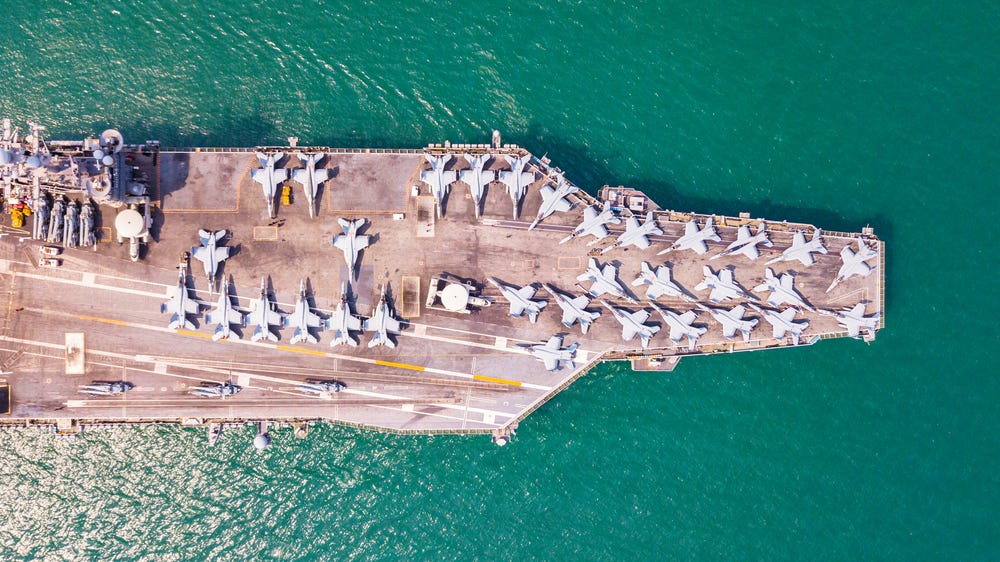
We’ve all been watching the build-up of US forces in the Middle East over the last few weeks, threatening to attack Iran unless the Ayatollah’s regime bow to numerous, steep demands including the handover of all enriched Uranium to the US, no renewed enrichment, and the total destruction of Iranian nuclear facilities, all without offering any concrete commitment to immediate and lasting sanctions relief, which Iran really wants. As usual there’s a great deal of feverish, and often wild, speculation in the media so here we shall attempt to answer the two fundamental questions that underpin this all; to what end, and when?
On 17th June 2025, a full five days before the USA joined Israel in attacking Iranian nuclear facilities on 22nd June, we published this article forewarning of US strikes. Much of that article remains highly relevant and accurate to the current situation, so we recommend reading it in full, but we summarise the key “to what end” points below:
Nuclear Weapons. Iran should certainly not have a nuclear weapon, and the 2025 strikes did not entirely halt Iranian nuclear weapons development, only slowed it. Bombing Natanz, Isfahan and Fordow again is highly unlikely to change this. Only the widespread deployment of ground troops, not only to these sites but to anywhere else that enriched materials and associated technologies have been squirrelled away, could have any hope of halting the programme. Even then, Iran could rebuild once again, since they have domestic Uranium mines. In truth then, the only way to stop Iranian nuclear weapons development is for the Iranians to decide to stop it themselves. That is only achievable if either the current regime decides to stop – which it certainly won’t without exacting significant sanctions relief in the least – or another, new regime takes over and decides to stop. So, halting Iranian nuclear weapons development is not an achievable aim for the coming strikes.
Regime Change. “There are only two real routes to regime change in Iran – and both involve people on the ground. As Kosovo showed, air power alone is not enough.” No nation, not the USA, not Israel, not even a vast coalition, has the appetite for a ground invasion of Iran. The disaster of Iraq looms large in collective memory, and Iran would be even more challenging. The only viable route towards regime change therefore is to co-opt the boots of the Iranian people themselves. Yes, in recent weeks there has been considerable unrest across Iran, but the brutal grip of the regime remains in place and has inflicted innumerable casualties amongst the brave souls that have resisted. Could a coordinated air campaign reduce the strength of Iran’s security forces sufficiently to enhance the Iranian people’s chances to prevail? Maybe, but there is zero guarantee, and there is just as much chance, if not more, that even were the clerics’ regime to fall the IRGC would take over, instead of the people – which is a worse outcome for everyone concerned.
So really, the challenge that President Trump faces here is that he has amassed a vast, and very expensive, air and sea armada that is ready to strike at Iran, but doesn’t have any significant achievable objectives for this armada to pursue. The reluctance of his military chiefs to commit to any objective is telling confirmation of this.
Political intent has met the brick wall of military reality.
But Trump is also facing another brick wall, and one of his own making – by amassing this armada, and through his own bluster and rhetoric, he has committed himself to doing … at least something. Without a (highly unlikely) vast concession from Iran that he can tout as a victory he must carry out his threats of military action. And so, what we are likely to see is a range of strikes on Iran that are more punitive and symbolic rather than oriented at achieving any particular, tangible objective.
When?
There’s been much talk of the cost of deploying the US armada, and the urgency that this cost adds to either using it or bringing it home. Much of the operating cost of many of the assets that comprise this armada, such as aircraft carrier groups, is a sunk cost; sailors need paying regardless if they’re stateside or in the Arabian Sea, so it is rather false to add this sunk cost into the mix. Forward-basing aircraft, munitions, and personnel into the region from bases elsewhere does cost – this required fuel, food, rents, parts and supplies that were on top of the existing sunk costs of paying pilots and ground technicians stateside. But really, how concerned do we think President Trump is about US taxpayers’ money being spent on his desires? Have you glanced at his taxpayer funded golf trip history lately? So, cost is not a key factor for Trump.
Markets are a key factor for Trump. The moniker TACO (Trump Always Chickens Out) emerged after analysts noticed a key pattern in his decision-making; when stock prices tank in relation to a decision or action that Trump has made, Trump backs off. This is why we would not be surprised at all if US punitive strikes on Iran occur over a weekend – perhaps even this very weekend, 28th February to 1st March, once the markets close in the evening of Friday 27th February (tonight). What might delay the attacks until a later weekend is the ongoing US-Iran talks, the third round of which occurred rather inconclusively in Geneva this week, and the fourth round of which will take place in Vienna next week (2nd March).
Thing is, as above, first, the US’ demands are steep and the US’ offers appear hollow to the Iranians, second, Trump is not exactly known for his patience, and third, the Iranians appear to be deliberately stringing out these talks, as they often do – testing Trump’s patience and suggesting the Iranians haven’t quite understood how dangerous the current situation really is.
Israel is also an important factor. Netanyahu has unprecedented access and influence over the Trump administration, but there are two other interesting factors to consider aside from Israel’s desire to destroy the Ayatollah’s regime and the Iranian revolution in general; Narendra Modi and Purim. India’s Prime Minister Narendra Modi visited Israel this week and spoke at the Knesset. Quite naturally, neither the US nor Israel want to provoke the inevitable Iranian retaliatory drone and missile strikes on Israel whilst the leader of one of the worlds biggest economies, and largest democracies, is visiting. And Modi left Israel yesterday, on Thursday 26th February. And then Purim. Purim, which this year begins in the evening of Monday 2nd March and ends on Tuesday 3rd March, is a key Jewish holiday that commemorates the saving of the Jewish people from a massacre by Esther, Queen of Persia (i.e. Iran), who appealed to her husband the King on behalf of the Jewish people when the King’s chief minister, Haman, plotted a massacre. This might seem a rather flimsy reason to schedule a military campaign, but if you look back through Israel’s military history you’ll find that key Jewish dates feature regularly – whether by Israel’s choice or their enemies’ (see Yom Kippur, 1973). It won’t be a decider, but it does contribute.
Conclusion
Trump has painted himself into a corner, once again. Despite the vast size and power of the US’ armada, bolstered by Israeli forces no less, the opportunities to achieve strategic objectives such as destroying Iran’s nuclear programme or changing the regime are exceedingly slim, if not wholly unrealistic. Nonetheless, to save political face both at home and abroad, Trump is compelled to act – if only by ordering punitive strikes and displaying power. And as to when, well, this very weekend is more likely than not the crunch point.
Iran’s response? Hunker down, survive the strikes, fire salvoes of missiles and drones at Israel in particular, plus US bases in Bahrain (port), Qatar (Al Udied), and UAE (Al Dhafra). They may also choose to disrupt regional air travel with limited strikes on airports that force airspaces to be shut down and force airlines to bow to insurer demands, and attack shipping in the Strait of Hormuz that forces shipping companies to also bow to insurer demands – thereby affecting global oil and LNG prices given that 25-30% of global oil & LNG flows through that strait, and hitting Trump in a key pain point – gasoline pump prices. And once the strikes are over? Emerge, claim victory over the Great Satan and Little Satan, tighten the oppressive grip on the long-suffering Iranian people, and rebuild.
The sad thing is, there is in fact a viable route to resolve this to everyone’s but the clerics’ and regime zealots’ satisfaction. Recall that one of the greatest mistakes made during the Iraq invasion was the wholesale disbandment of not only the ruling Ba’ath Party but also the Iraqi military. As a result, both state apparatuses mobilized against the coalition. What the US and Israel could do in Iran is to appeal to a select few more commercially-minded members of Iran’s military apparatus (remembering that the IRGC in particular is deeply entwined into Iran’s business world), suggest that they could remain in power and enrich themselves if they only overthrow/ dispose of the clerics and their more zealous military colleagues, quash the nuclear programme, and utilize Iran’s existing governance apparatus combined with increasing sanctions relief to exact real and lasting change for Iran, at a pace that does not provoke war, civil war, widespread unrest, or bloodletting.
But hey, that sensible option would be too much to ask, wouldn’t it?